Our leafy earth-friendly environment
Trees are a necessary part of our existence. Apart from providing a substantial portion of the oxygen we breathe, they're pretty. And when the weather is hot, they provide something we appreciate even more: shade which some of us hold dear in our hearts.
Seattle is widely known for two things: trees, and rain. They go hand-in-hand. When it rains, the ground gets moist and trees roots soak the moisture up. They spread their canopies of leaves and boughs, giving us that world-famous luxuriant ambiance.
I wouldn't want to live anywhere else in the world.
Over my years as a Seattle native, I've had a number of encounters with trees.
The first goes back to my days as a Boy Scout leader. One of our younger scouts liked to use his hands in sometimes destructive ways.
Photograph by Michael Heavener.
During one camping trip in the national forest, he spent an entire weekend defacing every tree within a hundred feet of our campsite. He wasn't cutting the trees down. He was stripping the bark off them.
Foresters call this girdling, and it's fatal to the tree.
We tried taking away his hatchet. Unfortunately, his father, apparently oblivious to reasonable parenting, had brought an axe and allowed his son to use it.
When we told the father that damaging trees in the national forest was illegal, he asked, quite sincerely: "Why? Beavers do it all the time."
Well, yes. But beavers are engaged in productive dam building and watershed enhancement. They aren't maliciously destroying trees around their campsite.
Needless to say, neither father nor son was invited on any more camping trips.
Then there are the trees that humans plant with the best of intentions. Back in the 1980s, Redmond planted rows of young trees along the city's sidewalks.
At the time, it seemed like a perfectly reasonable civic project: beautify the streets, provide shade, make the city a nicer place.
Forty years later, those saplings have grown into mature trees. Their roots are pushing up sidewalks, creating all sorts of problems. And in the fall, our 2020s streets are covered with leaves, making driving a bit bothersome.
Sometimes a tree becomes a problem simply because it grows very, very well.
Three houses down from us was a beautiful, tall old-growth spruce. It was a landmark in the neighborhood. Redmond's regulations require approval before certain trees can be removed within the city limits, so it was disappointing when the city approved removing this one.
We stood in the street and watched the arborists take it down. They were dropping four-foot sections of trunk, and each one hit the ground with a tremendous boom.
Eventually we understood why. That spruce had grown to about six feet in diameter, and it was pushing hard against the foundation of the house. At that point, the choice was pretty simple.
The tree had to go—or the house did.

Photograph by Michael Heavener.
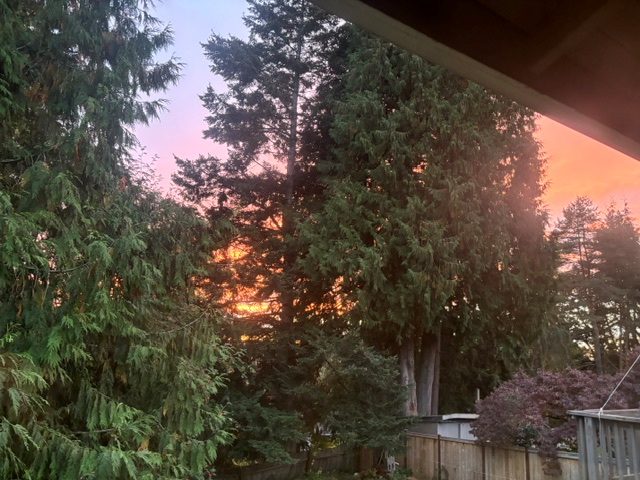
And then there's the cedar in our own backyard. It's a second-growth cedar, and cedars are wonderful shade trees.
In fact, ours provides so much shade that there's a thirty-foot circle underneath where practically nothing else grows.
My grandchildren discovered another interesting property of cedars. The ground beneath it is almost impenetrable to shovels designed for little hands. A garden hose helps soften the soil, and they've been excavating water-saturated dirt for weeks.
Unfortunately, they've managed to loosen quite a few rocks downstream in the property's retaining wall, which are now beginning to fall down the embankment toward our neighbor's house.
So I've learned a few things about trees.
Don't let a Boy Scout loose with a hatchet when he's pretending to be a beaver.
If you become a government official, think carefully about what might happen next when you plant trees.
When a forest pioneer grows to six feet in diameter, pay attention to what it's doing to the nearest house.
And if children are causing a flood under your cedar tree, maybe it's time to call a halt to the excavation.
Trees are wonderful.
But like most things in life, they work best when we understand what we're getting ourselves into.
© 2026 Michael Heavener